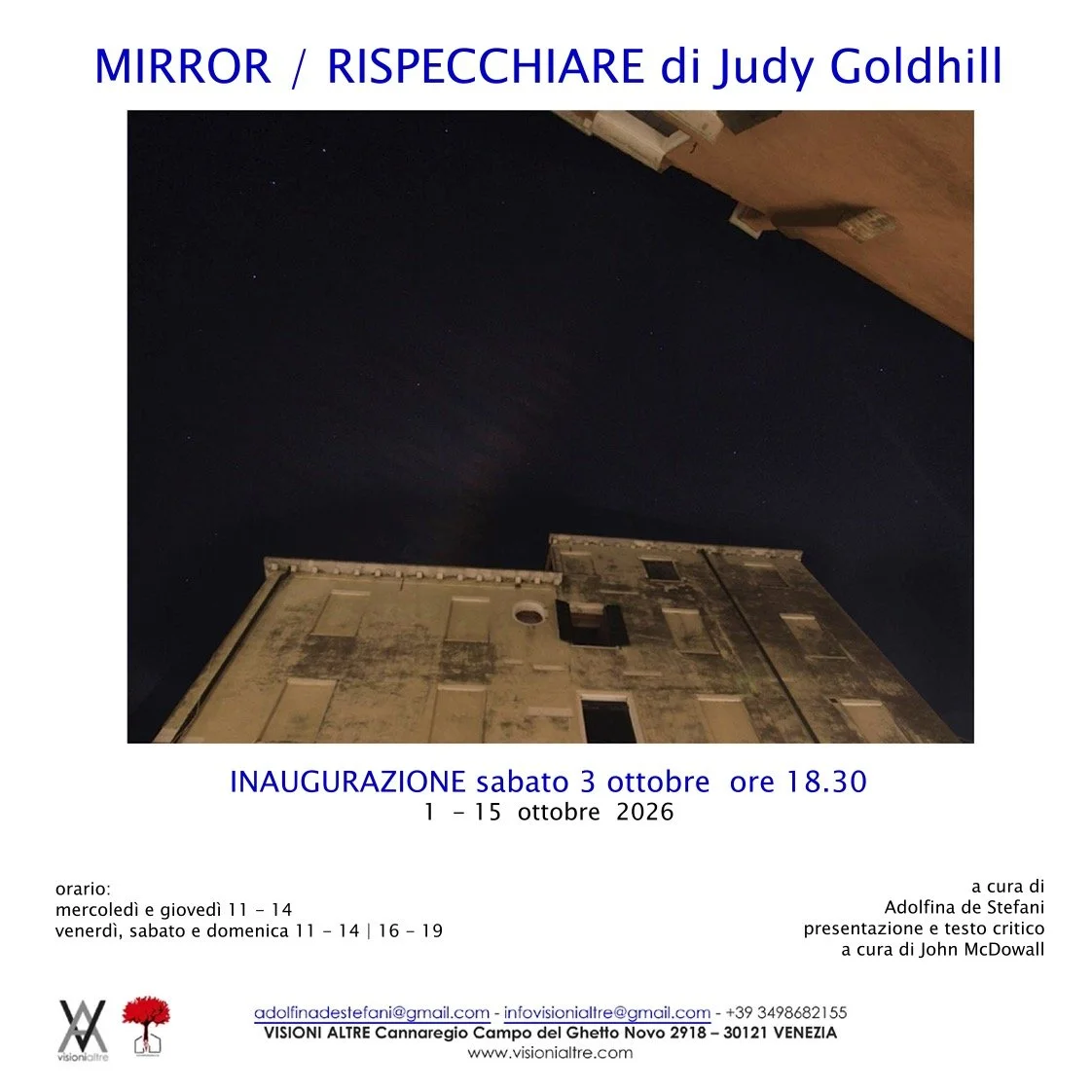
‘Mirror / Rispecchiare’ presents new work by London-based artists Judy Goldhill and Sophie Loss, developed through direct engagement with the spaces of VISIONI ALTRE and the unique historical and architectural layering of the Venice Ghetto.
The exhibition brings together two distinct artistic practices united by a shared reflection on the relationship between space, perception, memory, and representation. Through photography, construction, and three-dimensional interventions, the artists craft a site-specific response, establishing a dialogue between the artworks, the gallery’s architecture, and the historical context in which it is situated.
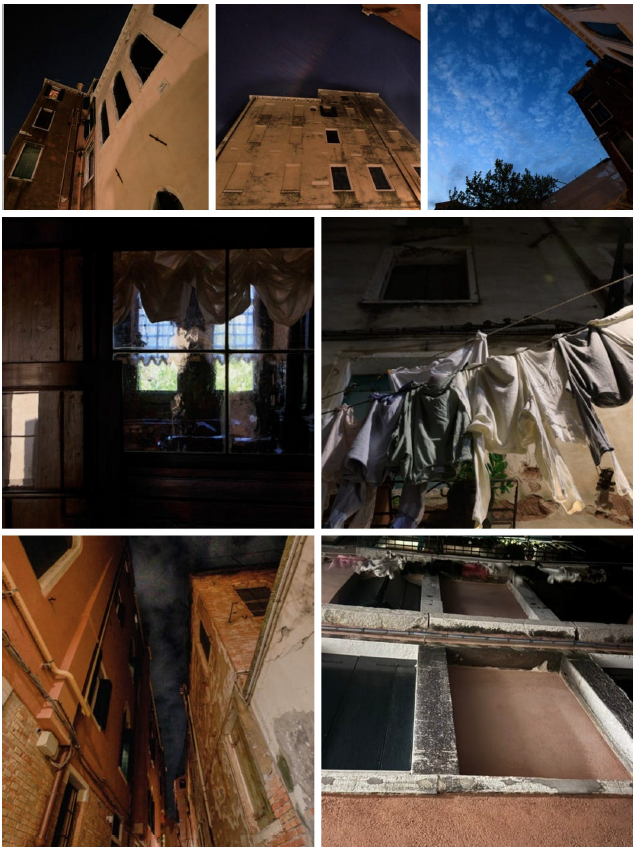
Judy Goldhill’s work focuses on the architecture of the Ghetto and its relationship with the atmospheric and cosmic realms. Her photographs, presented as windows, offer a dense, layered view of the buildings, highlighting their connection to the sky. The architectural fabric, marked by time and the memory of confinement, thus enters into a tension with the openness of the celestial expanse. Darkness, stars, and shifting light become recurring elements through which the image transcends a mere recording of the site, opening up a reflection on permanence, loss, and the possibility of bearing witness.
Sophie Loss, meanwhile, addresses the perception of space through a series of constructed works accompanied by their corresponding photographic reference images - a reflection of the surrounding city. Created primarily from paper and card, these structures rely on processes of layering and overlapping, to generate a deliberate visual instability. Constructed shadows, apparent reliefs, and voids challenge the distinction between surface and depth, and between object and image, thereby altering the viewer's customary modes of orientation - a reflection of the surrounding city.
In both bodies of work, the location serves not merely as a backdrop but becomes the very substance of the artistic inquiry. The physical dimension of architecture intertwines with the immaterial realm of memory and perception, while the act of looking becomes a tool for questioning both the visible and the hidden.
The title ‘Mirror / Rispecchiare’ alludes to this process of reciprocity: the works reflect one another and the site that houses them, while simultaneously offering the viewer an unstable image of the space and of their own perception. The exhibition thus proposes an experience in which no view can be considered definitive: what appears as reality may transform into an image, while an image may take on a concrete yet ambiguous presence.
Employing distinct artistic languages, Goldhill and Loss share an exploration of the threshold between the real and the represented, presence and absence, matter and image. ‘Mirror / Rispecchiare’ invites us to view the exhibition space not merely as a place of observation, but as a perceptual and mnemonic device capable of unlocking new interpretations of the site and its layers of meaning.
The project is curated by John McDowall.
VISIONI ALTRE. Canaregio Campo Del Ghetto 2918 30121 VENEZIA. 1-15 October 2026
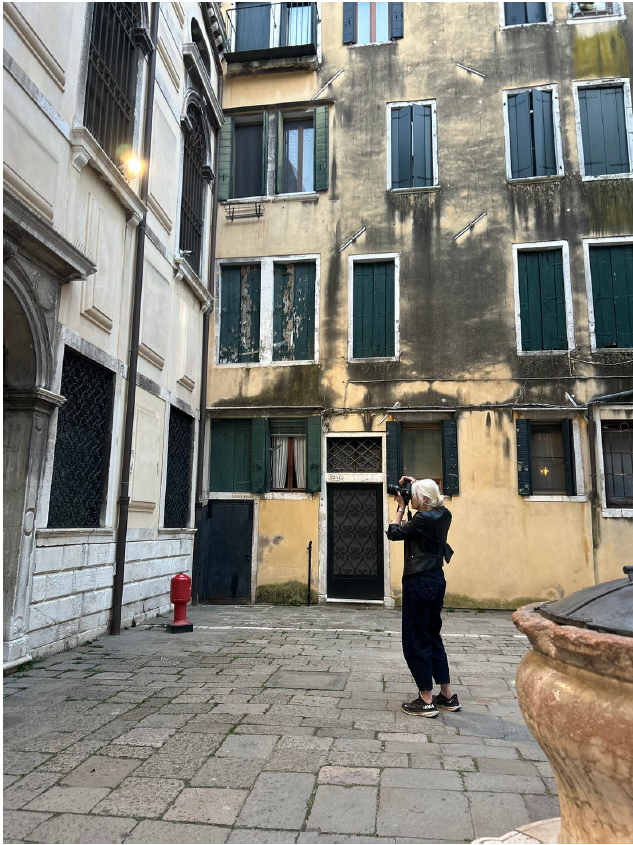
Photograph by Naomi Gryn
Judy Goldhill
Architecture in tension with the Venice sky
NAOMI GRYN
OCT 03, 2026
It’s a warm spring dawn in Venice’s Jewish Ghetto. A street cleaner is sweeping the Campo di Ghetto Nuovo. Judy Goldhill is staying at the Locanda del Ghetto. She has been up for much of the night, creating images for an exhibition due to open in October at the Visioni Altre gallery on the other side of the square, next to the Chabad centre where, the previous evening, women in long skirts and men in white shirts enthusiastically welcomed in Shabbat.
Venice Ghetto, photographs by Judy Goldhill
Apart from the blossoming Lubavitch community, the Ghetto — a must see on the itinerary of 300,000 tourists a year — has five ornate synagogues: the German synagogue, Schola Francese, built by Jews from the south of France, the Italian synagogue, the Levantine and theSpanish synagogue. All are on the upper floors of buildings because Venetian authorities required Jewish places of worship to be inconspicuous. The varying styles of these synagogues are testament to the different communities that made up Venetian Jewry. From the outside, they might appear to form a cohesive whole, but cohabiting in such a tightly packed space with people whose traditions, customs and ways of worship were not your own must have brought many challenges. Many of us, I suspect, would have found it cacophonous and claustrophobic.
Judy’s work depicts the Ghetto’s dense, layered architecture in tension with the sky. That isn’t exactly what she had originally intended. “I was seeking evocations of the confinement of the ghetto, and the oppression or liberation of the night sky, but elements conspired against me.”
There was light pollution, as well as armed police insisting that Judy needed a permit to take photographs or use a tripod, even though she had confirmed earlier that day with Dario, the genial historian who works in the Ghetto ticket office, that this would not be necessary.
Even so, Judy’s powerful photographs contrast the vast reaches of the sky with earthly human construction — not just brick-and-stone buildings but also the social constructs we invent, such as community and segregation. The windows captured in these images, and reflected in their framing, also invoke the glassmaking in which Venetian Jews have been involved for some 500 years, and the glass trade in which they have played a part since the 14th century. Curiously, the Ghetto is much less oppressive than Judy had remembered. The Campo Nuovo is a wide, welcoming piazza, where both Jews and non-Jews are free to come and go as they please. But there is a sadness in the fact that this gem of a Jewish quarter now requires a roaming police presence.
On the wall of Judy’s hotel, underneath the Italian synagogue, is a sign in Hebrew: Zecher leChurban, “in memory of the destruction”. The word in Hebrew: Zecher leChurban, “in memory of the destruction”. The word churban evokes both the destruction of the Temple in Jerusalem and, in modern usage, the destruction of European Jewry. Here, in the heart of the former Ghetto, the two meanings seem to gather together.
In the 1940s, 246 Jews were deported from Venice; only eight would return. That more Venetian Jews did not perish was, in large part, thanks to the immense heroism of the Jewish community’s leader,GiuseppeJona,whokilledhimselfratherthanhandovertotheNazisalistofthecity’sJews
In the rollercoaster that is Jewish history, Napoleon tore down the gates of the Ghetto in 1797, bringing to an end 281 years of Jewish separation in Venice. Yet with the recent resurgence of antisemitism, perhaps Jews are once again safer gathered together, where they can be protected by armed guards.
Judy’s images are about the Ghetto without being confined by it, inviting us to look upwards and outwards from a place whose history is so deeply marked by walls, boundaries and separation, and to reflect on what lies beyond them.
Mirror / Rispecchiare, a joint exhibition by London-based artists Judy Goldhill and Sophie Loss, curated by John McDowell, runs from 2–14
October 2026 at Visioni Altre, Cannaregio, Campo del Ghetto Nuovo 2918, 30121 Venice.
Opening hours: Wednesday and Thursday, 11am–2pm; Friday, Saturday and Sunday, 11am–2pm and 4pm–7pm
Judy Goldhill, John McDowall and Sophie Loss. Camera Kyle Middleton